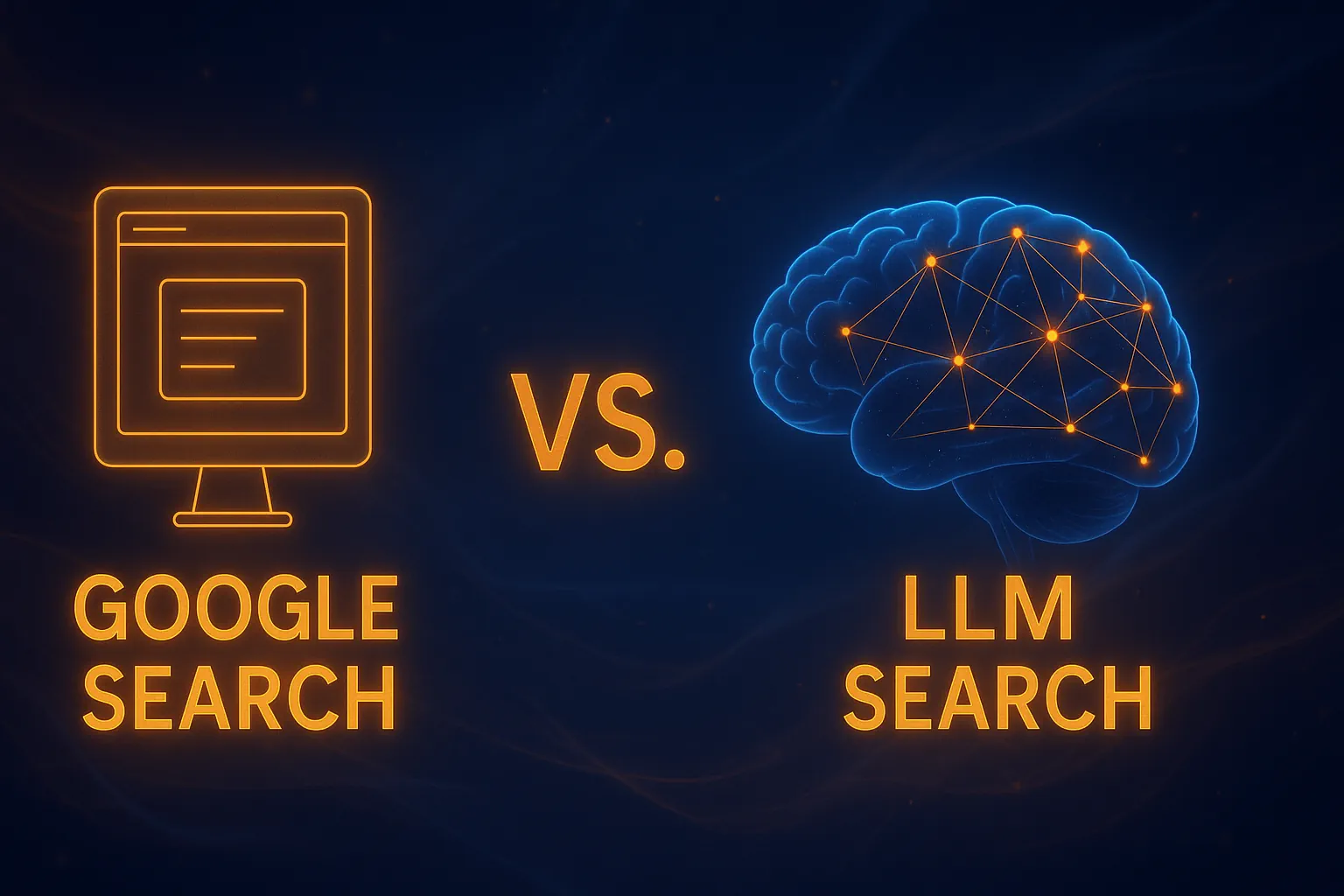
For more than two decades, SEO has revolved around one principle: ranking web pages in Google.
But as large language models (LLMs) like ChatGPT, Claude, and Grok reshape how users find and consume information, visibility is shifting, from ranking URLs to recognising knowledge.
In this post, we’ll explore how Google Search and LLM-based systems differ, why optimising individual pages won’t make you “rank” in AI models, and how to build long-term visibility by strengthening your brand’s semantic footprint.
Google Search: A URL-Centric System
Google’s ecosystem is built around one simple idea: every piece of content lives at a URL.
How Google Search Works
- Crawling – Googlebot discovers pages via links and sitemaps.
- Indexing – Each URL is parsed, structured, and stored in Google’s index.
- Ranking – Algorithms evaluate pages based on relevance, content quality, backlinks, and E-E-A-T.
- Display – Users see a ranked list of links (SERPs) to click through.
For Google, the page is the atomic unit of knowledge.
That’s why traditional SEO focuses on optimising pages — with meta titles, content hierarchy, schema markup, and link structures.
LLM Search: An Entity-Centric World
LLMs such as ChatGPT, Claude, and Grok don’t rank URLs — they synthesise knowledge.
When you ask an LLM a question, it doesn’t search for the “best link.”
It recalls or retrieves information it already understands about entities, like brands, products, people, and topics — and connects them into a coherent answer.
For an LLM, the entity (your brand, product, or expertise) is the atomic unit of knowledge.
That means the model doesn’t “index” your website the way Google does.
It builds a semantic understanding of what you do, informed by how your brand appears and is described across the web.
Google vs LLM: The Core Difference
| Dimension | Google Search | LLM / AI Search |
|---|---|---|
| Unit of Knowledge | URL / Page | Entity / Concept |
| Data Source | Indexed web pages | Trained / retrieved semantic data |
| Ranking Logic | SEO signals (E-E-A-T, backlinks) | Factual accuracy & contextual trust |
| Output | List of ranked links | Synthesised answer |
| Goal | Direct users to sites | Deliver complete, verified information |
| Visibility Metric | Rankings, CTR, impressions | Mentions, citations, model confidence |
Google is a retrieval engine.
LLMs are reasoning engines.
One finds pages. The other connects meaning.
Why Page-Level SEO Doesn’t “Rank” in LLMs
Optimising a single page won’t suddenly make your brand appear in ChatGPT or Perplexity.
There is no “SERP” inside an AI model.
But that doesn’t mean those pages are irrelevant, quite the opposite.
Every optimised piece of content strengthens the semantic profile of your brand:
- reinforcing what you’re known for,
- providing factual data that LLMs can trust, and
- signalling topical expertise.
So while Google SEO builds discoverability, LLM optimisation (GEO) builds understanding.
Optimising for LLM Visibility
To appear as a trusted reference in AI-generated answers, you need to help LLMs understand, connect, and verify your brand.
Key Actions:
Entity clarity – Use schema.org, Wikidata, and consistent naming conventions.
Answer-friendly content – Write concise, factual, and context-rich text that AIs can easily summarise.
Semantic linking – Connect related entities (brands, locations, products) within your content.
Consistency – Align tone, claims, and data across all your pages and social platforms.
Authority signals – Gain mentions and references from credible, thematically relevant sources.
The New SEO Balance
The future isn’t about choosing between Google and AI search, it’s about balancing both ecosystems.
| Focus | Google SEO | LLM Visibility |
|---|---|---|
| Primary Goal | Rank URLs | Build brand understanding |
| Signal Type | Content & backlinks | Factual consistency & reputation |
| User Outcome | Clicks to your site | Mentions in AI responses |
| Optimization Method | Technical & on-page SEO | Semantic + entity optimization |
Traditional SEO brings users to your site.
Entity-focused SEO ensures your brand is understood by machines, and cited when people ask AI systems about your topic or products.
The Takeaway
Google ranks pages. LLMs recognise knowledge.
You can’t “rank” in AI models,
but you can shape how they describe and trust your brand.
The next evolution of SEO isn’t just about keyword rankings.
It’s about owning your semantic territory, ensuring that when an AI talks about your industry, your brand is part of the answer.