
Google Suggest in 2026: Still One of the Most Useful Signals We Have
Search has changed. We now deal with AI Overviews, LLM-powered answers, Perplexity rewriting queries, and ChatGPT Search reshaping discovery entirely. But despite all of that, one thing hasn’t changed at all:
People still express their intent through language.
Language is still the way users naturally form questions, make comparisons or reveal uncertainty. Now matters more in 2026 than it did five years ago. Because LLMs aren’t replacing user intent; they’re inheriting it.
This is exactly why I built this free Chrome extension. Not to create another SEO tool, but to collect the raw phrasing people actually use. And with the newest update, it’s become a simple, stable and surprisingly powerful way to understand how users think before they search, and how LLMs interpret those thoughts before they generate an answer.
Why This Matters for SEO, AI Overviews and LLM Visibility
Autocomplete isn’t “keyword research.”
It’s behaviour research.
LLMs expand queries, infer subtopics, and generate answers using the same linguistic patterns users feed into the system. When people consistently phrase something as a “how” question, a checklist, a comparison or a risk, LLMs adopt that structure too.
That means understanding Google Suggest gives you a head start in three areas:
1. Aligning content with AI answer structures
AI Overviews, ChatGPT Search and Perplexity often follow the same mental frameworks users express in autocomplete.
2. Identifying the subtopics LLMs will infer
Autocomplete shows which ideas, concepts and entities naturally cluster around your topic.
3. Spotting gaps early
If users expect something your content doesn’t cover, you’re unlikely to appear in generative answers.
This tool surfaces those patterns instantly. No models. No dashboards. Just raw user language — the kind LLMs emulate.
What’s New in the 2026 Update
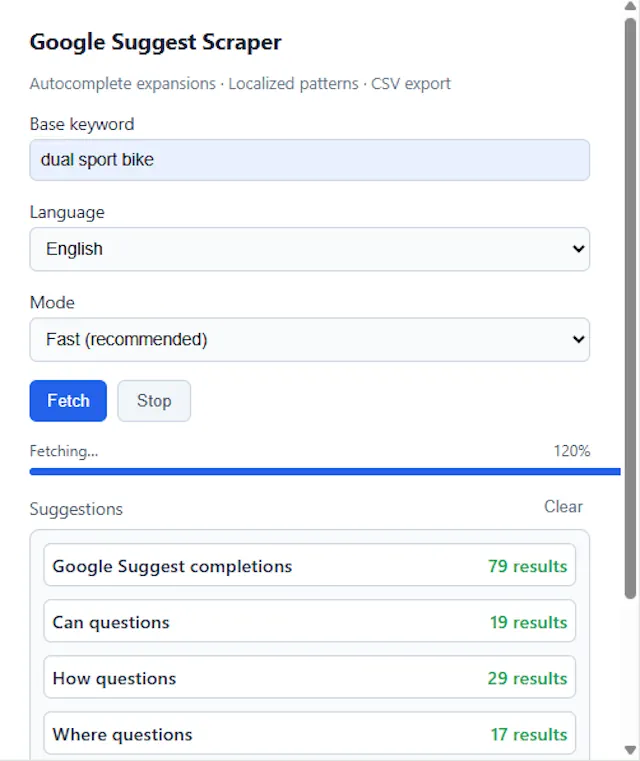
This version is built to be fast, stable and actually pleasant to use.
Fast Mode replaces the old A–Z scraping approach with a focused set of expansions. It gives you the same insights without hitting Google with unnecessary requests — which means almost no blocking and a much smoother experience.
Deep Mode is still there for full alphabet coverage, now handled with natural pacing, retry logic and safer request behaviour.
The interface shows progress per category, updates in real time and feels more transparent. Localisation works properly across English, German, French, Spanish and Polish. And under the hood, the request logic behaves more like a human and less like a hungry bot.
You run it, it shows you how people phrase things, and you get on with your work. Simple.
A Quick Example: “AI SEO visibility” in the UK
Run this phrase through Fast Mode and the patterns appear instantly. Visibility blends with strategy, ranking clarity, tools, AI search engines, and PR-like authority signals. Users aren’t asking about volume; they’re trying to understand how AI changes the visibility game.
These aren’t keywords — they’re clues.
They show what users expect to see.
And because LLMs mirror those expectations, the insights go straight into how you structure your content.
If you want your brand to appear in AI answers, AI Overviews or LLM-powered citations, understanding these patterns is one of the most reliable ways to start.
Why It’s Free
This isn’t a SaaS product.
It’s a simple tool that solves a real problem: understanding the language behind intent and I hope it will be useful for some of you.
No login.
No subscription.
No upgrade offer lurking somewhere in the UI.
Download the free Chrome Exentesion here or just search in the Chrome Web Store for “Google Suggest Scraper”
Just a clean, free way to explore how people think when they search — and to align your content with the patterns LLMs increasingly rely on.