
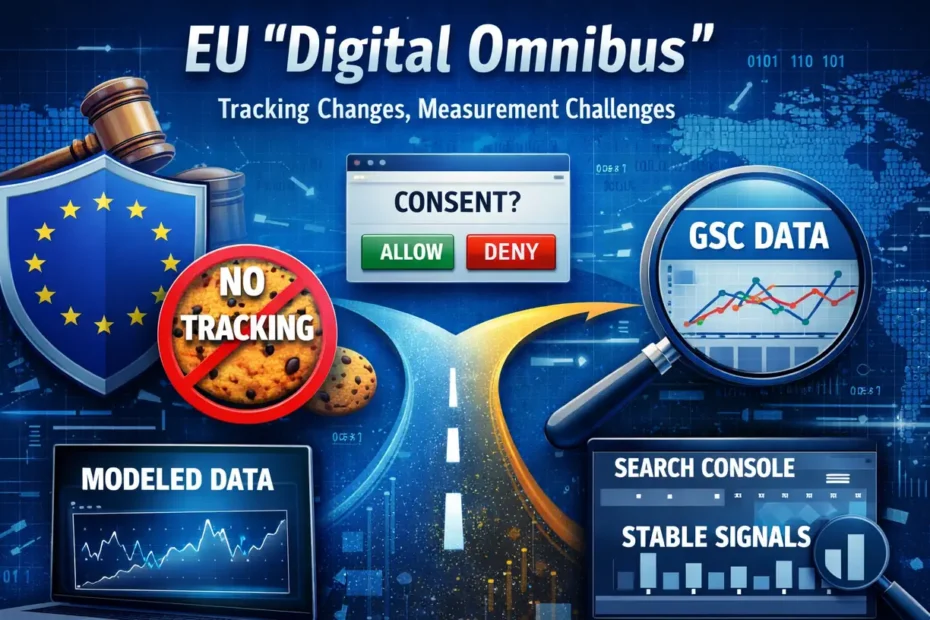
The EU “Digital Omnibus”: what it means for SEO and paid (mostly: measurement) — and why it’s not a crisis
You’re going to see more chatter about the EU “Digital Omnibus” over the next year. Some of it will be useful. A lot of it will be people trying to turn regulatory housekeeping into an urgent “replatform your analytics now” sales pitch.
This isn’t that.
The Omnibus matters less because it changes how Google ranks websites, and more because it reinforces the direction of travel we’ve already been living with: less reliable behavioural tracking, more governance, more ambiguity in attribution.
And yes — that’s SEO and SEA. If anything, paid feels it sooner, because so much of modern PPC performance is built on tracking signals feeding automation.
What the Digital Omnibus is (and isn’t)
The Digital Omnibus is a European Commission proposal package (published 19 November 2025) that bundles targeted amendments across a range of EU digital legislation, framed as “simplification” and “streamlining”.
It isn’t a new “SEO law”. It doesn’t rewrite Google’s ranking algorithm. It’s about how digital rules are structured and enforced, with knock-on effects for the parts of marketing that depend on tracking and data collection.
One proposal strand marketers should pay attention to: the package includes ideas that would reshape cookie/terminal equipment rules. nudging them closer to GDPR thinking and pushing towards more standardised, machine-readable consent signals (think browser/system-level preferences rather than endless banner roulette).
Also worth saying plainly: it’s not final. It still has to go through the EU legislative process, so specifics can change.
If you want the source document, it’s here:
https://digital-strategy.ec.europa.eu/en/library/digital-omnibus-regulation-proposal
Why you can’t shrug and say “EU problem”
If you have any EU audience at all, you don’t get to treat this as background noise. Compliance expectations and browser behaviour tend to converge, and vendors build for the biggest regulatory gravity wells.
Even if you’re UK-only, the UK already requires consent for most non-essential cookies and similar tracking tech under PECR, enforced by the ICO. This isn’t a free-for-all on this side of the Channel.
So the relevance isn’t “will this change SEO or PPC?”. It’s: “will this change what we can measure reliably, and how confident we should be when we interpret the numbers?”
The impact on SEO and SEA: not rankings, measurement
Here’s the part that matters for working SEOs, PPC leads, and marketing directors:
Marketing performance is increasingly judged through analytics. And analytics is increasingly constrained.
The Omnibus sits in the same trendline as everything else we’ve been dealing with:
- more users declining tracking
- more browser restrictions on storage/identifiers
- more scrutiny on what gets collected before consent
So GA4 (and every other analytics tool) becomes more of a model of reality, and less of a record of reality.
GA4 is still very useful, especially with Consent Mode, but you need to stop pretending it’s an accounting ledger. “Behavioural modelling” can fill gaps when users decline analytics cookies, using patterns from consenting users. That can keep reporting usable, but it’s also, by definition, modeled.
Why paid media feels this more sharply
SEO suffers when post-click behaviour becomes harder to observe. Paid media suffers twice: it loses some visibility and some of the signals that feed optimisation systems.
If conversion tracking coverage drops or becomes noisier, you’ll see knock-on effects in:
- attribution (especially cross-device and multi-touch)
- remarketing/audience building (smaller pools, less precision)
- automated bidding (less signal in, more guesswork out)
This isn’t “PPC is dead”. It’s “PPC becomes more sensitive to measurement quality”. There’s a difference.
“Should we switch away from GA4?”
Not as a reflex.
Tool choice is mainly about governance and control (where data is processed/stored, contractual comfort, features, internal policy). A different platform can be a better fit for some organisations. But it doesn’t magically override consent choices or browser limits. The constraints are structural, not vendor-specific.
The more useful question is: are we using whichever tool we have with realistic expectations and defensible implementation? If yes, you’re already ahead of most of the market.
What stays solid: Search Console (and why that matters)
One piece of good news: Google Search Console is largely insulated from cookie consent issues because it reports search-side data (impressions, clicks, queries, positions) from Google’s systems — not relying on your site setting cookies or running tracking scripts.
What will keep happening, though, is that GSC clicks and GA4 “organic sessions” drift further apart on many sites as tracking coverage changes. That’s not proof your SEO collapsed. It’s often proof your measurement assumptions did.
(And yes, paid has its own version of this: platform-reported results vs on-site analytics vs CRM numbers rarely line up perfectly. That gap tends to widen when tracking gets patchier.)
So what should you do with this (calmly)?
If you run SEO or paid, or you’re the person who has to explain results to a board, the pragmatic move is to adjust how you evaluate performance.
Focus more on durable signals:
- Search Console visibility and clicks (for SEO demand/visibility)
- landing page performance (what actually converts)
- conversion outcomes the business recognises (orders, qualified leads, revenue)
- trend direction over time
Treat user-level stories (returning users, pathing, “perfect attribution”) as nice-to-have, not as the foundation of decision-making.
And for paid specifically: put more emphasis on conversion quality and definition (what counts as a meaningful conversion) than on perfect journey reconstruction. When signals are scarcer, quality matters more.
Timeframe
The Omnibus is a proposal, but credible reporting points to meaningful effects landing more in the 2027–2028 window, with some elements (like AI Act timing) discussed as moving into late 2027 territory.
That gives you time. Use it to improve your measurement posture and reporting honesty, not to run around buying new dashboards.