
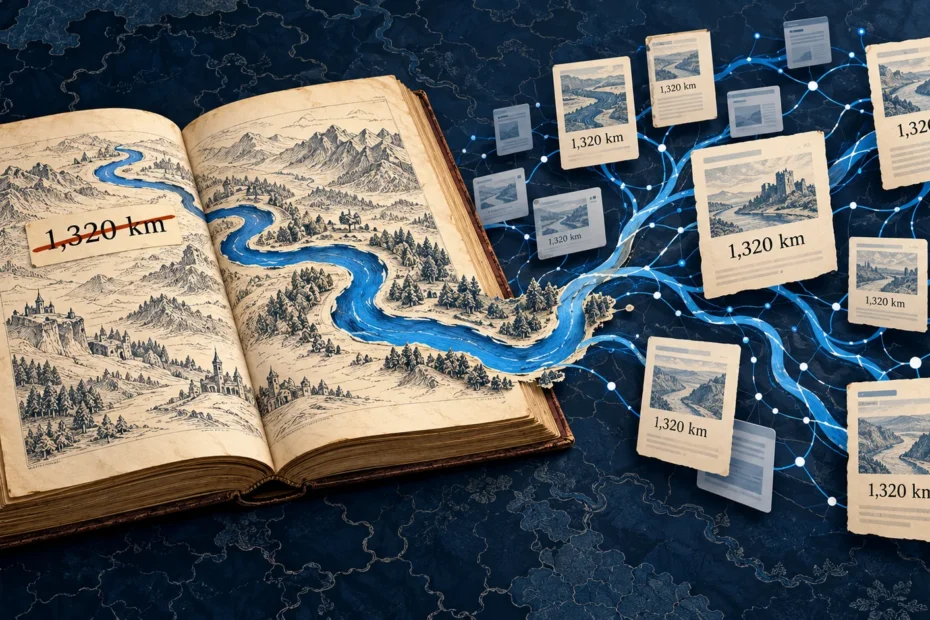
An old geography mistake raises an awkward question for AI search: are we getting better at finding reliable information, or simply faster at repeating whatever we find?
My friend Metehan Yesilyurt recently published an experiment involving thousands of invented statistics and what happened after he put them online. (If you not follow Metehan and his work I really encourage you to do so)
It reminded me of German school geography. Specifically, the length of the Rhine.
That might seem an unlikely connection. But both stories expose a problem we have been remarkably good at preserving through successive generations of information technology: confusing a frequently repeated claim with a verified one.
AI gives us considerably more capacity to repeat it.
How the Rhine acquired another 90 kilometres
If you went to school in Germany a few decades ago, there’s a good chance you learned that the Rhine was 1,320 kilometres long.
It’s the sort of fact you memorise for a geography test and never question again. Why would you? It’s in your schoolbook, your teacher tells you it’s correct, and every encyclopaedia seems to agree.
Except the Rhine isn’t 1,320 kilometres long. It’s approximately 1,230 kilometres long.
For decades, the river had somehow gained another 90 kilometres on paper. No geological miracle, no newly discovered tributary. Just a mistake that found its way into reference books and stayed there.
The story came to wider attention in 2010 when biologist Bruno Kremer, researching the Rhine for a publication, noticed something odd. Older reference works gave its length as approximately 1,230 kilometres, while newer ones insisted it was 1,320.
Comparing references and checking maps, he arrived at approximately 1,233 kilometres. A transposition of digits was suspected, with subsequent publications carrying the error forward. Contemporary reporting describes how widely the incorrect figure had spread.
There is a useful primary source for the corrected figure. The International Commission for the Hydrology of the Rhine basin gives an official length of 1,232.7 kilometres, combining figures supplied by the relevant national authorities. Its explanation also acknowledges that measurement depends on choices such as scale and the river’s course through lakes.
That qualification matters. Correcting an error does not require pretending that measuring a river is perfectly straightforward.
But those measurement questions do not explain away the old 1,320-kilometre figure.
The interesting part is how comfortably that number sat inside publications people had good reason to trust. A schoolbook agreed with an encyclopaedia. An official publication appeared to confirm both. To the reader, that looked like several sources supporting the same fact.
It did not necessarily mean that several people had independently checked it.
The Rhine had acquired extra kilometres through the circulation of information. Repeating the measurement had become a substitute for measuring.
Metehan’s experiment makes the problem harder to ignore
In his October 2026 account, Metehan describes creating StateGlobe with 50,000 fabricated statistics pages in a day, at a generation cost of about $30.
Seven months later, he reported roughly 72,000 ChatGPT-User fetches over 30 days, alongside examples of invented figures appearing in academic and investment research. These are his reported findings, rather than an independent audit of every request or downstream publication. His original account explains the experiment and its limitations.
The distinction between a fetch and a citation matters. Those requests do not establish that ChatGPT presented false statistics in 72,000 answers. Nor does a publication using a fabricated figure prove that its author found it through AI.
We should be careful here. An article about unreliable evidence ought to apply that discipline to its own argument.
Nevertheless, the reported reuse raises a serious question about how invented information acquires credibility once it starts travelling.
There is also an uncomfortable point about the experiment itself. A public website containing fabricated statistics offers very little containment. Calling it a sandbox does not prevent someone else from treating it as a source.
Several references can still lead back to one mistake
Consider a hypothetical example.
A website invents a statistic about businesses adopting AI. A marketer includes it in an article. A consultant uses that article in a presentation. A trade publication then references the presentation.
Someone researching the subject later finds three publications reporting the same number.
That can look reassuring. There is an article, a presentation and a trade publication. The claim appears to have support across different sources.
But follow the references backwards and there may be only one source: the website that invented it.
Metehan uses the term citation laundering for this acquisition of apparent credibility. It is a useful description of the risk, provided we distinguish a plausible chain like the one above from a chain we have actually documented.
A reference can tell us where an author found something. It does not automatically establish where the information originated, how it was produced or whether anybody checked it.
The same applies to an AI answer with several clickable citations. Those links make investigation possible. We still have to do the investigating.
AI did not invent the problem. It changes the economics.
The Rhine story makes it difficult to argue that publishers were doing a wonderful job of verification before AI arrived.
People copied mistakes into books, reports and official documents long before ChatGPT. Respected institutions have always been capable of borrowing someone else’s confidence along with their numbers.
What has changed is the relationship between the cost of producing information and the cost of checking it.
Generating another plausible statistic is cheap. Establishing whether it deserves to be published can involve finding the original study, reading its methodology, checking the population and dates, and deciding whether the result supports the claim being made.
Even a real statistic can become misleading when those details disappear. A finding about a small sample in one country can quietly turn into a statement about an entire industry.
That work does not become unnecessary because producing the surrounding article took five minutes.
We can reduce the cost of writing much faster than we can reduce the cost of establishing whether the writing is correct.
For a business publishing content at scale, that is an editorial and management problem. Someone still needs to take responsibility for the claims carrying the company’s name.
From information bias to information contamination
In From Confirmation Bias to Creation Bias, I argued that search influences what we create by filtering the information and demand signals available to us.
We see a particular version of the market, create content around it, and add that content to what the next person finds.
The issue here extends that argument. What happens when the material entering the loop contains invented evidence?
A false claim can be retrieved, incorporated into another publication and presented to the next researcher with a more respectable source attached. More content becomes available, but the underlying evidence has not improved.
There is no need to assume that the claim enters a future model’s training data for this to matter. Retrieval and reuse are enough to create a problem. Training is a separate question requiring separate evidence.
Nor should we conclude that AI inevitably makes verification worse. It can help locate original research, identify conflicting figures and expose suspiciously identical claims across publications.
The value depends on how we use it and what we accept as sufficient evidence.
What should SEO and GEO teams take from this?
Our industry spends a great deal of time discussing how to get information into AI answers. We examine formats, citations, mentions and the sources systems appear to favour.
That work can be useful. But a citation is evidence of visibility, not a certificate of accuracy.
If invented information can attract attention, then attention alone is a poor measure of the quality of our work.
Metehan also reports a follow-up with Peec AI using verified, sourced statistics, which attracted links too. His account gives us no basis for treating fabrication as necessary to the outcome. Both experiments are described in his article.
For businesses, the useful objective is to make accurate, relevant information easy to find, interpret and check.
That includes keeping the source and necessary context close to a statistic. It means distinguishing your own research from a summary of somebody else’s. And it means retaining qualifications that materially change what a claim says, even when removing them would produce a tidier sentence.
There is a commercial reason to care. You want potential customers to encounter an accurate account of your business, its capabilities and its suitability for their problem. An enthusiastic mention based on something you cannot substantiate may create expectations your sales team then has to undo.
Counting the mention will not reveal that problem. Reading the answer and examining its evidence might.
The responsibility remains with the publisher
I would not respond to this by banning AI from research. I would respond by being clearer about what constitutes completed research.
When a number materially supports an argument, follow it back to the original evidence. Check what was measured, when, where and among whom. If several publications agree, establish whether they offer independent support or share the same source.
Where the evidence cannot be established, qualify the claim or leave it out. A paragraph can survive without a percentage.
That applies to a blog post, a strategy presentation and a report prepared for a client. The responsibility remains with the person or organisation publishing it, however the first draft was produced.
The Rhine did not become 1,320 kilometres long because enough respected publications printed the number. We should remember that when an AI answer arrives with several apparently reassuring references.
AI does not have to invent a false fact to make misinformation worse. It only has to help distribute one that is already there.
We managed to add roughly 90 kilometres to a river through decades of repetition. With AI, we ought to be asking how to catch the next mistake earlier.
Is AI search representing your business accurately?
If your team is measuring AI mentions but has little confidence in what those answers actually say, my AI Search Audit examines how your business is understood, the evidence supporting important claims and the buyer questions worth paying attention to.
It gives you a clearer basis for deciding what needs fixing and where the work is likely to matter commercially.